
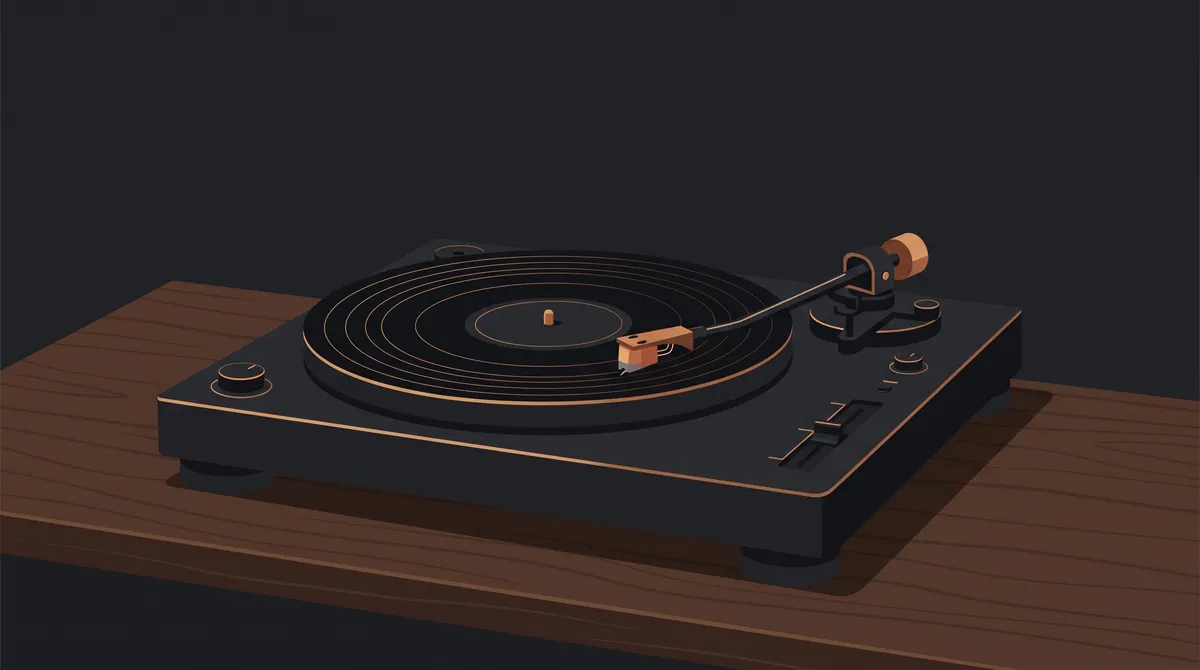
What Is Vinyl? Why Listen to It Today?
Vinyl records are an analog physical medium—sound is engraved as physical grooves on a plastic disc, and the stylus converts mechanical vibration back into electrical signal as it tracks the groove. It's a fundamentally different listening experience from digital: no sampling, no encoding, no compression—just continuous analog waveforms.
Buying vinyl isn't about "better sound than digital." Vinyl's dynamic range and frequency response actually don't match modern digital formats. The value is in the ritual: flipping the record, lowering the needle, waiting for the music to start—a slower, more focused way to listen.
What Does a Vinyl System Need?
Vinyl isn't just buying one turntable. A complete system has four key parts:
1. Platter & Chassis
The platter spins the record at a stable speed. Heavier, flatter platters reduce wow and flutter—more mass means better inertia and speed stability.
- Entry: Acrylic or metal platter on dense MDF chassis
- Mid: Metal platter with felt mat, damped chassis materials
- Avoid: Cheap plastic platters—audible speed drift and distortion
2. Tonearm
The tonearm's job is to track the groove with precise, steady pressure—not too heavy (wears the record), not too light (skips).
- Entry: Straight tonearm with precise bearings
- Mid: Adjustable VTA (vertical tracking angle) and azimuth
- Key: Entry tables like Pro-Ject are pre-set—no adjustment needed for beginners
3. Cartridge
The cartridge is the most sound-defining link in the chain. Two main types:
- MM (Moving Magnet): 3–6 mV output, easy to drive, entry-level favorite. Ortofon 2M series (Red / Blue / Bronze / Black) is the classic choice.
- MC (Moving Coil): Only 0.2–0.5 mV output, finer detail retrieval, but needs an MC-specific phono stage (higher gain, lower impedance load). For advanced listeners.
4. Phono Stage
Cartridge output is tiny—it needs amplification plus RIAA equalization (the standard curve applied when cutting records, reversed on playback to restore correct frequency response).
- Many integrated amps have a built-in MM phono input—check for "PHONO" on the back
- MC cartridges need a dedicated MC phono stage
- If your amp lacks phono in, budget for a separate phono stage
Key Specs Explained
Wow & Flutter
A measure of speed stability, expressed as a percentage. Lower is better:
- Below 0.2%: Acceptable
- Below 0.1%: Very good
- Below 0.05%: Flagship level
Most audible on sustained notes—piano, cello, vocals—where pitch wavering becomes noticeable.
Tracking Force
The pressure the stylus exerts on the record, in grams. Each cartridge has a recommended value (usually 1.5–2.5 g). Too heavy wears the record and stylus; too light causes skipping and mistracking.
Speed: 33⅓ vs 45 RPM
Most LPs are 33⅓ RPM. 45 RPM is usually for EPs/singles, with slightly better sound due to wider grooves and faster speed.
Common Myths Debunked
Myth: Vinyl sounds better than digital?
By objective measurements, vinyl's frequency response (~20 Hz–20 kHz) and dynamic range (70–80 dB) don't match CD (96 dB) or Hi-Res streaming. Vinyl's "warmth" comes from analog character and ritual, not technical specs.
Myth: Automatic turntables are better?
The opposite. Automatic mechanisms add complexity, noise, and error sources. Most mid-to-high-end tables are manual—you lower and lift the arm yourself. That's part of the ritual.
Myth: You need an expensive turntable to start?
No. Entry-level models already include a pre-mounted cartridge, pre-set tracking force, and usable phono input. There's huge upgrade headroom, but the starting point doesn't need to be high.
Myth: Just buy a turntable and you're done?
Not quite. You need: turntable + phono stage (if your amp lacks one) + amplifier + speakers. Or choose an entry model with built-in phono stage and Bluetooth (like the Pro-Ject T1 EVO BT) for plug-and-play simplicity with powered speakers.
First-Time Buyer Checklist
- Turntable (with tonearm and pre-mounted cartridge)—choose one with a pre-mounted cartridge to skip setup hassle
- Phono stage—if your amp has no PHONO input on the back
- Amplifier & speakers—or powered speakers
- A record you love—this is the whole point
- Basic care kit—anti-static brush, stylus cleaner
How to Split Budget?
Suggested: 50% turntable, 25% cartridge, 25% phono stage. Don't pair an entry table with a flagship MC cartridge—the table's own resonance will cap performance. Upgrade the cartridge when you upgrade the table.
Featured Picks
- Pro-Ject T1 EVO BT: The easiest entry point. Built-in MM phono stage and Bluetooth—just connect powered speakers or Bluetooth speakers and start listening. No extra gear needed.
- Pro-Ject Debut Carbon EVO: The classic entry-to-mid table. Carbon fiber tonearm, metal platter, pre-mounted Ortofon 2M Red—many enthusiasts' first "serious" turntable.
Book a listening session to experience vinyl's analog warmth firsthand. Our team will help you plan the right first vinyl setup based on your budget and existing system.