If you search forums for "Topping DX5 II review" or "DX5 II impressions," you'll find this desktop DAC/headphone amp combo among the most frequently recommended options in its price range. On ASR (Audio Science Review), 83% of 533 voters rated it "Great." What makes it so popular? This article covers the specs, sound and real-world experience.
Design and Build
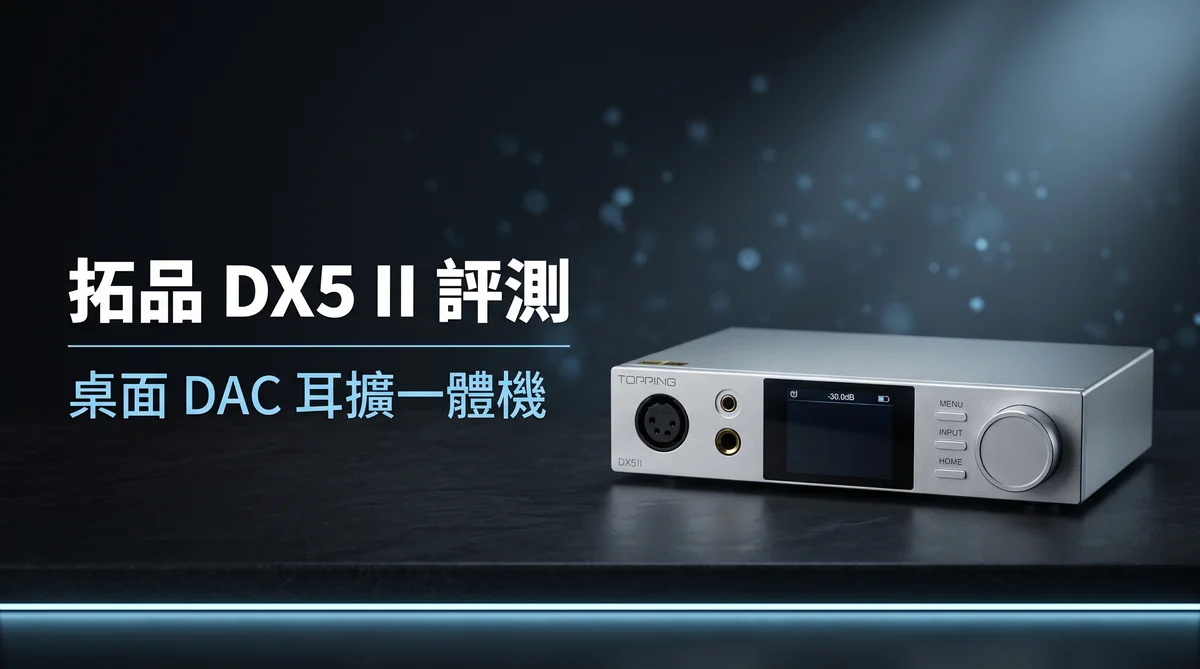
The DX5 II follows Topping's familiar aluminum chassis design. The front panel features a 2-inch color display, a large volume knob and three buttons. Headphone outputs include four-pin XLR balanced, 4.4mm balanced and 6.35mm single-ended — an uncommon combination at this price level that covers three connector types out of the box.
The rear panel is equally comprehensive: XLR and RCA line outputs for active speakers or power amps, plus USB-B, coaxial, optical and Bluetooth (LDAC) inputs. A 12V trigger output allows integration with other audio gear.
Key Specs: Dual Chips + Balanced Amp
The DX5 II uses two ESS ES9039Q2M DAC chips — one per channel for independent left/right decoding, a design normally found on more expensive units. ASR lab measurements show 133dB SNR and THD below 0.00006%, essentially unheard of at this price.
The headphone amp uses Topping's proprietary X-Hybrid fully balanced circuit, delivering up to 7600mW into 32Ω. That's enough power to drive nearly any IEM or full-size headphone — even demanding planar magnetics like the Audeze LCD series.
Two bonus features: a 10-band PEQ (parametric equalizer) and a remote control.
Sound: Neutral, Clean and Detailed
The DX5 II delivers classic "scientific hi-fi" sound — neutral, clean and transparent with minimal coloration. This means faithful to the recording, though listeners who prefer warm, lush tonality may find it too clinical.
Treble extension is smooth with good harmonic detail without harshness. Midrange density is solid, with natural vocal texture. Bass control is excellent — switching to high gain clearly improves low-end authority and tightening.
Compared to the Fiio K9 AKM, the DX5 II has a slightly smaller soundstage but more authentic tonality — the Fiio sounds sweeter but with obvious coloration. The background is exceptionally quiet; even sensitive IEMs show no hiss.
Who Is It For?
- Desktop listeners — one box replaces DAC, amp and preamp.
- Owners of multiple headphone connectors — XLR, 4.4mm and 6.35mm covered.
- Measurement-minded enthusiasts — ASR numbers are class-leading.
- PEQ enthusiasts — 10-band parametric EQ works with Oratory1990 profiles.
How Does It Compare to Other Topping Models?
- DX5 II vs D50 III: The D50 III is a DAC-only unit (no headphone amp). If you already have a separate amp, it's cheaper. Otherwise the DX5 II is the better all-in-one.
- DX5 II vs D90 III SABRE/Discrete: The D90 III is a flagship standalone DAC with greater resolution, but requires a separate headphone amp. The DX5 II is the desktop all-in-one; the D90 III is for more serious systems.
- DX5 II vs DX9 Discrete: The DX9 Discrete is a higher-tier flagship combo with 16-phase PSRM architecture and even better measurements, at a significantly higher price.
Conclusion
The Topping DX5 II is a hard machine to beat at its price. Dual DAC chips, balanced amp, comprehensive connectivity, PEQ and remote control — this combination is nearly unique in its price bracket. The 83% "Great" rating on ASR speaks to its strong reputation among international audio enthusiasts.
If you're looking for a desktop DAC/amp that delivers flagship-level measured performance without flagship pricing, the DX5 II should be at the top of your list.
Want to hear the DX5 II alongside other Topping DACs?
Book a listening session and compare it with headphones matched to your preferences.
📧 ian@clarityd.com