Topping D900 Review: Proprietary 32-Phase PSRM Discrete 1-Bit Flagship DAC, Measured and Heard
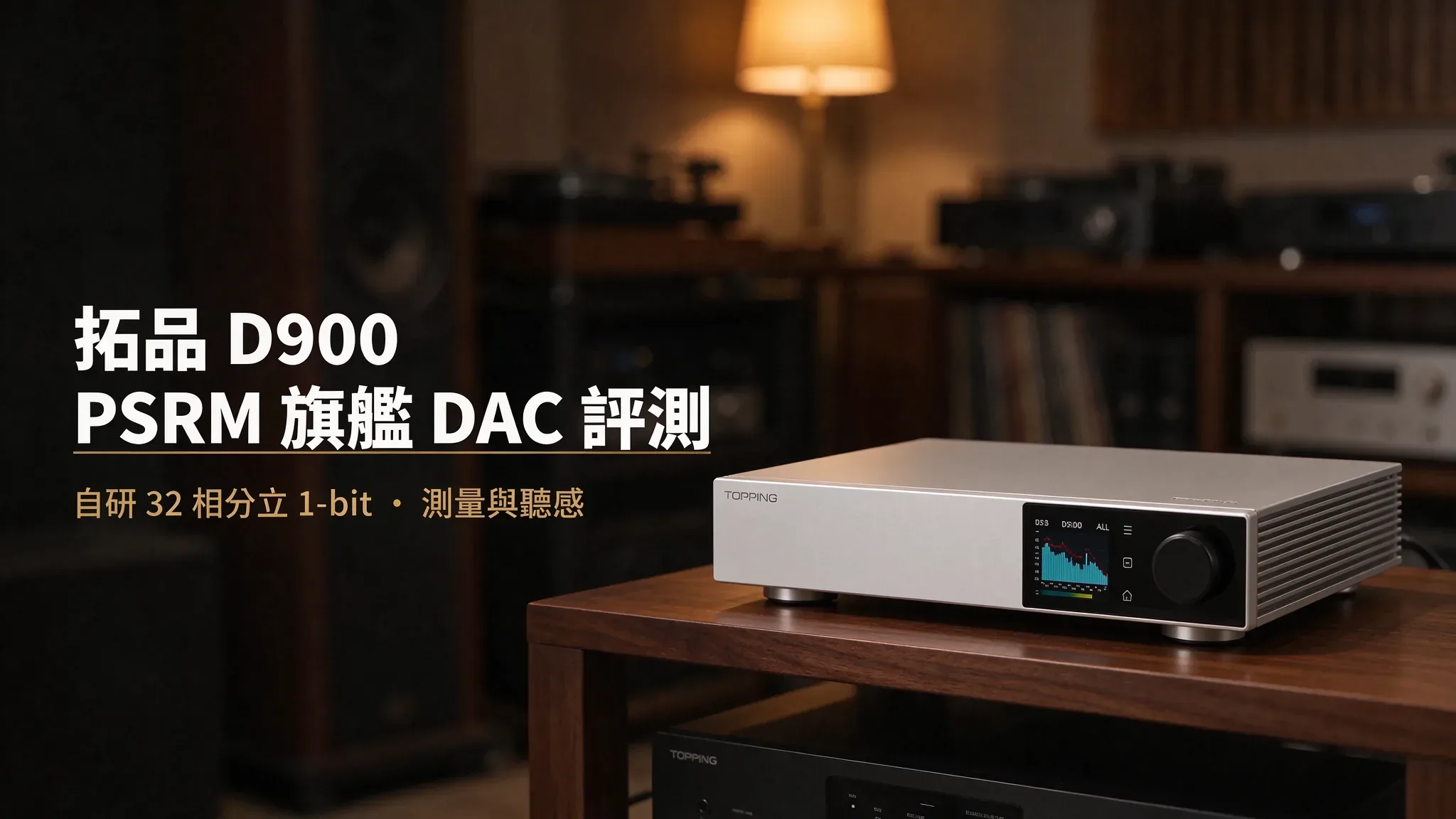
The Topping D900 is the brand's current ultra-flagship standalone DAC and preamp. Instead of an AKM or ESS integrated chip, it uses Topping's own 32-phase PSRM discrete 1-bit decoding architecture. Audio Science Review (ASR) founder Amir measured it and called it one of the most complete custom DACs he has seen. This Topping D900 review rounds up the official specs, third-party measurements and listener impressions to examine its sound, strengths, trade-offs and who it suits.
Design and Build
The D900 uses Topping's flagship-series horizontal aluminum chassis. The front panel carries a 2-inch color touchscreen, three touch buttons and a large volume knob; an aluminum remote is included for input switching and level adjustment from the listening seat. The unit supports automatic source switching and a 12V trigger for easy integration into a full system.
Its positioning should be clear first: the D900 is a DAC plus preamp only. It has no built-in streaming module and no headphone output; headphone amplification is handled by the companion A900 headphone amp, and a separate Pre900 preamp is also available. On the analog side there are balanced XLR outputs only: a fixed-level Line Out and a variable-level PRE preamp output, with no single-ended RCA. Digital inputs are comprehensive: USB-C, USB-B, two optical, two coaxial, AES/EBU and I²S LVDS (HDMI), plus Bluetooth 5.1.
Decoding Architecture: Proprietary PSRM Discrete 1-Bit
PSRM (Precision Stream Reconstruction Matrix) is Topping's own discrete 1-bit decoding architecture. Each channel uses 32 individual components in a 1-bit module: each audio sample is converted into a high-speed pulse stream running at millions of pulses per second, with pulse density expressing the signal level, before an internal filter reconstructs the analog signal. The HiFi and Music Source review notes that despite its discrete appearance, it is closer in principle to a 1-bit delta-sigma converter than a resistor-ladder R2R design.
Per the official specifications, the D900 uses 32 discrete elements per channel in a fully balanced architecture. SNR (A-weighted, 1kHz) is 131dB, with matching 131dB dynamic range; THD+N (A-weighted, XLR) is below 0.000055% at 1kHz, and unweighted THD over a 45kHz bandwidth is below 0.00015% from 20–20kHz. Channel crosstalk is -147dB at 1kHz, channel balance 0.3dB, and output impedance 100Ω.
Sample-rate support varies by input: USB and I²S handle up to PCM 768kHz/32bit and native DSD512, with DSD256 over DoP; coaxial, optical and AES/EBU top out at PCM 192kHz/24bit and DSD64 over DoP. Bluetooth 5.1 supports LDAC, aptX Adaptive, aptX HD, aptX, aptX Low Latency, AAC and SBC, with LDAC and aptX Adaptive up to 24bit/96kHz.
Output level has 4V and 5V settings: Line Out delivers 4.2Vrms and 5.2Vrms respectively, while the PRE preamp output reaches 10.5Vrms (4V mode) and 13.0Vrms (5V mode). Frequency response is 20Hz–20kHz (±0.3dB) and 20Hz–40kHz (±1.0dB). Dimensions are 33.0 × 5.7 × 21.0cm, and weight is 2.52kg.
Third-Party Measurements: ASR and HiFi and Music Source
ASR measured via USB input, preamp output at -2.0dB volume: RMS around 4.11Vrms, THD+N 0.000075%, and SINAD 122.533 / 122.512dB. Maximum output is around 12.91V, with the best performance near 10.3V. The high output voltage lets a power amp run at its lowest gain setting, improving overall system SNR. Multitone distortion reaches reference-class levels; the jitter floor is extremely low and clean, with only two inconsequential tones around -140dB; filter attenuation is excellent, with a tiny 0.2dB droop at 20kHz. The elevated wideband noise plus distortion is attributed by ASR to ultrasonic noise shaping and is not an audible concern.
Amir's conclusion: among custom DAC implementations, the D900 is one of the most complete he has seen, using a large number of discrete components to approach the level of state-of-the-art integrated silicon, with almost no penalty for the "discrete 1-bit" concept. Its price is high relative to IC-based solutions, but it represents a bargain next to high-end DACs of similar architecture that usually perform worse. Of 260 ASR forum voters, 58.8% rated it Great and 33.1% Fine.
Simon Wilce at HiFi and Music Source adds the usage perspective: build quality is solid, the preamp output and multiple output voltage settings are useful, it can pair with the A900 as a desktop stack, and it supports automatic source switching. The 10-band parametric EQ is set through the Topping Tune desktop or iOS app over a wired USB connection; it cannot be adjusted over Bluetooth, which is one practical limitation. He also notes that with only balanced XLR outputs, a passive preamp that accepts only single-ended RCA would need an adapter to integrate.
Sound: Transparent and Neutral, Silent Background, Clear Detail
Based on ASR forum A/B comparisons and Chinese listening reports, the D900 follows Topping's familiar neutral, transparent, clean-background direction, with clear detail retrieval and defined dynamic contrast that stays free of fatigue over long sessions. Direct comparisons against the D90 III Discrete split two ways: some users find the Discrete more neutral and clear, with the D900 sounding slightly softer and a fuller midrange; others prefer the D900's detail retrieval and blacker background. In short, listeners after monitor-style neutrality should compare the Discrete, while those who prefer a slightly richer, more forgiving presentation should listen to the D900.
These subjective descriptions come from forum users and listening reports; the final character still depends on the power amp, speakers, cables and source feeding it. Measurements reflect objective figures, while tonal character varies with the system and personal taste.
D900 vs the D90 III Line: Which to Choose?
- D900: 32-phase PSRM discrete 1-bit ultra-flagship, balanced XLR Line + PRE outputs, 10-band PEQ and high-voltage drive, positioned above the D90 III series for listeners wanting a flagship standalone DAC with preamp drive.
- D90 III SABRE: twin ES9039SPRO delta-sigma architecture, strong measured performance and a neutral, analytical sound with a full connectivity suite, for those prioritizing objective, transparent reproduction.
- D90 III Discrete: 16-phase PSRM discrete module with a more organic timbre, richer texture and better timing feel, for those who value musicality and tone.
Budget and system needs are the main divider: if you want the highest-spec discrete architecture, preamp output and strong drive voltage, the D900 is the top choice in the range; with a tighter budget, or if the measured limits of integrated silicon matter most, the D90 III SABRE and Discrete are worth comparing alongside it.
Who Is It For?
- Owners of a power amp or active speakers looking for a flagship standalone DAC and preamp — needing balanced XLR outputs and high-voltage drive.
- Listeners interested in discrete / custom 1-bit architecture and objective measurements — ASR measurements and official specs sit at the leading tier.
- Anyone needing 10-band PEQ room correction, comprehensive digital inputs, Bluetooth LDAC, a remote and 12V trigger for system integration.
- Those planning a flagship stack with the A900 headphone amp or Pre900 preamp.
Trade-Offs to Note
- Balanced XLR outputs only, with no single-ended RCA; passive preamps or equipment that accepts only single-ended input will need an adapter.
- No headphone output and no network streaming module: pair an A900 for amplification and add a digital transport or streamer for streaming.
- PEQ must be configured over a wired USB connection to a computer or iOS device; it cannot be adjusted over Bluetooth.
- The US price is US$1,799, positioned above the D90 III series; those on a tighter budget should compare integrated-chip designs at the same level first.
Conclusion
The D900 is Topping's push to take discrete 1-bit architecture into flagship territory: a proprietary 32-phase PSRM module, 131dB SNR, comprehensive digital inputs, 10-band PEQ and substantial preamp output voltage, with ASR measuring a SINAD around 122.5dB and issuing a recommendation. It suits enthusiasts who value transparent reproduction, objective data and balanced preamp drive. If you need RCA single-ended, a headphone amp or network streaming, those peripherals have to be planned alongside it. Whether it is worth buying depends on your system's connections, your budget and your tonal preferences.
Book an in-home audition to compare the D900 alongside other Topping DACs in timbre, detail and drive; we will arrange a comparison matched to your system and listening preferences.