Topping D90 III SABRE Review: Dual ES9039SPRO Flagship DAC, Measured and Heard
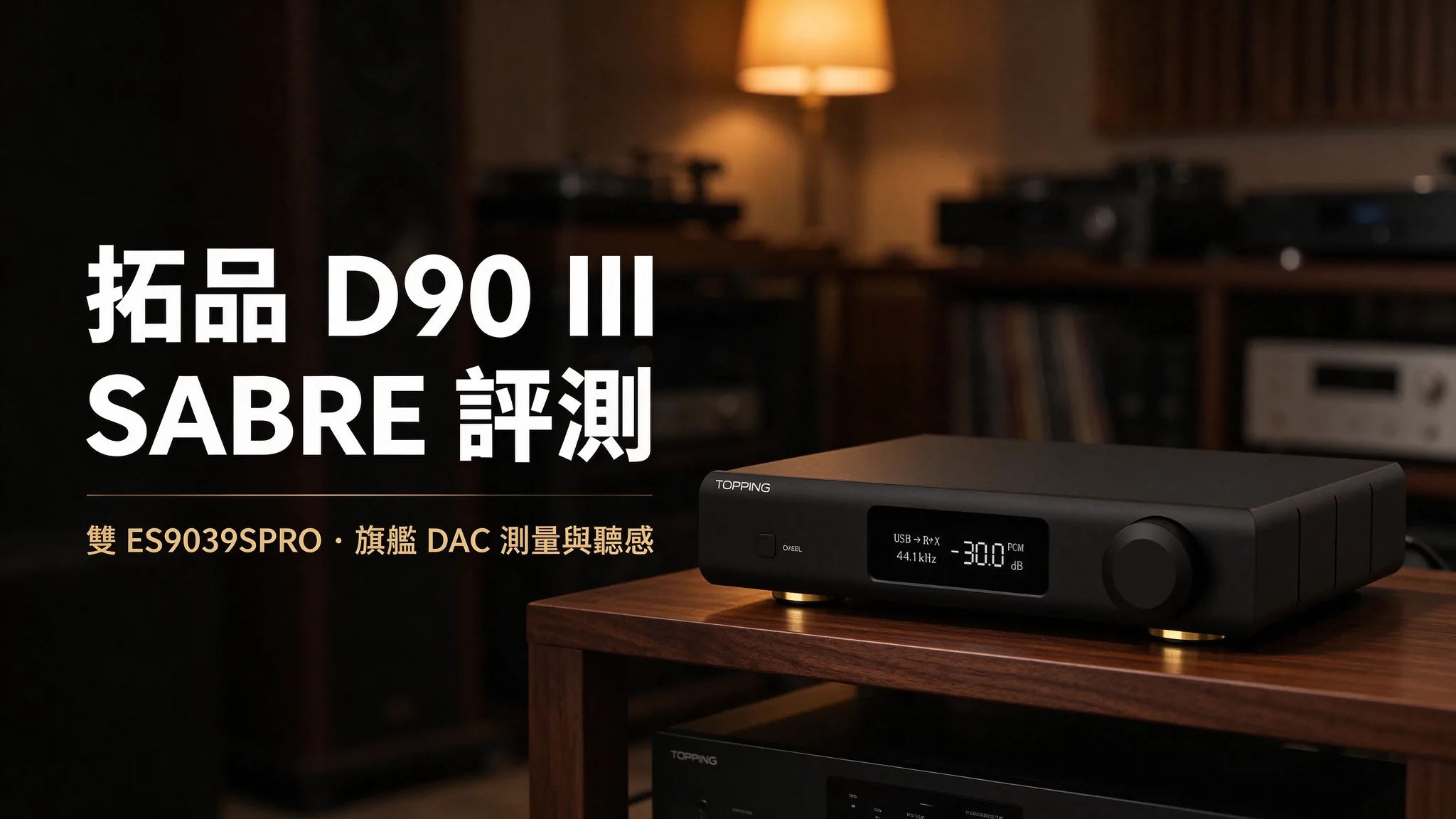
The Topping D90 III SABRE is the brand's current flagship standalone DAC, built around twin ESS ES9039SPRO converter chips. On the Audio Science Review (ASR) measurement charts it ties with the top-ranked DAC, and it is one of the best-measuring Topping converters ever tested. This review rounds up the official specs, third-party lab measurements and listener impressions to examine its strengths and who it suits best.
Design and Build
The D90 III SABRE uses Topping's familiar horizontal aluminum chassis, compact enough for a component rack or a desktop setup. The curved front panel carries a large volume knob and a 2.4-inch color touchscreen; a 2.4 GHz remote is included for switching inputs and adjusting volume from the listening seat. It comes in black or silver.
The rear panel is thoroughly equipped: analog outputs include both RCA and balanced XLR, with switchable 4V/5V output levels to match different power amps or active speakers. Digital inputs cover USB, optical, coaxial, AES/EBU and I²S, alongside Bluetooth 5.1, 12V trigger and preamp mode for integration into an existing system. Build quality feels solid, and the weight gives the chassis a steady, grounded feel.
Specs and Measured Performance
The converter stage uses one ES9039SPRO per channel for a dual-mono decoding architecture, with an XMOS XU316 USB interface and a CPLD clock circuit to control jitter. It supports up to 32-bit/768kHz PCM and native DSD512, with seven digital filters and selectable pure / tube-emulation / transistor-emulation listening modes.
Per the official specifications, THD+N is below 0.000045% on balanced XLR and below 0.00006% on RCA; SNR is 135dB (XLR) / 129dB (RCA), with matching dynamic range figures of 135dB / 129dB; channel separation is around -149dB on XLR and -133dB on RCA.
On the measurement side, ASR places the D90 III SABRE in a virtual tie for the top of its SINAD chart: near-perfect linearity, excellent intermodulation and multitone results, and exceptional dynamic range, with only minor room for improvement on jitter. In lab terms it belongs to the most transparent tier of converters currently available.
Sound: Neutral, Analytical, Clean and Transparent
The D90 III SABRE follows a classic scientific hi-fi direction: neutral and direct, a silent background, clear detail and separation, with little added coloration. Multiple measurements conclude that it does its job on the bench and keeps its own sonic personality minimal, faithfully reflecting the recording and the rest of the chain.
Subjectively, opinions split. Roughly half the listeners hear little to no coloration and a clean, faithful presentation; the other half feel that, next to more expensive reference DACs, the treble is slightly lit, the midrange a touch lean and the bass restrained, with vocals and strings less lush than warmer designs. These comparisons are relative to high-priced references rather than a measured tilt in the frequency response.
In terms of the frequency balance, the treble carries air and extension with a solid image; the midrange keeps vocal body without turning warm or lush; the bass is stable and tightly controlled, with a restrained rather than inflated low end. Compared with earlier generations, overall density and information retrieval have improved, and long listening sessions stay free of fatigue. It suits classical, vocals and jazz; if you listen mainly to heavy metal or hard rock, or prefer a warm, rich, strongly musical signature, you may find it too clinical. Final character still depends on the amplifier, speakers, cables and source feeding it.
SABRE vs D90 III Discrete: Which to Choose?
Sharing the same general chassis, the SABRE and Discrete versions use very different hearts:
- D90 III SABRE: twin ES9039SPRO delta-sigma architecture, neutral and analytical tonality, with class-leading measured performance — for listeners who prioritize objective, transparent reproduction.
- D90 III Discrete: Topping's proprietary 16-phase PSRM 1-bit discrete module, with a more organic sonic character, richer timbral texture and better timing feel — for those who value musicality and tone.
If you want lab-grade measurements and a full connectivity suite, the SABRE is the more direct choice; if you care more about tonal thickness and flowing musicality, the Discrete is worth comparing alongside it.
Who Is It For?
- Measurement-minded audio enthusiasts — SINAD, distortion and dynamic range sit at the current leading edge.
- Owners of a power amp or active speakers looking for a flagship standalone DAC — needing AES, I²S and balanced XLR among its inputs.
- Listeners focused on classical, vocals and jazz who prefer a neutral, clean tone.
- Anyone wanting Bluetooth LDAC, a remote and preamp mode integrated into an existing system.
Conclusion
The Topping D90 III SABRE is a standalone DAC that pushes measured performance into flagship territory: its ASR standing and official figures are top-tier, its connectivity is complete and its build is solidly engineered. It suits enthusiasts who value transparent reproduction and objective data; those who prioritize musical warmth or have a tighter budget should consider the Discrete version or a more affordable transparent-class converter.
Further Reading
- Topping D90 Review: How Good Is This Flagship DAC?
- Topping DX5 II Review: The Best Value Desktop DAC/Amp Combo?
Book an in-home audition to compare the D90 III SABRE alongside other Topping DACs in sound and measured performance; we will arrange a comparison matched to your system and listening preferences.